Borderline Personality Disorder Treatments – Evidence-Based Options That Can Help
Living with intense emotions, unstable relationships, and a shaky sense of identity can feel overwhelming. If you or someone you care about is navigating these challenges, you are not alone — and effective borderline personality disorder treatments do exist. Understanding your options is a powerful first step toward clarity.
This guide breaks down the most widely supported treatments for borderline personality disorder, from specialized therapies to medication management. You will learn what each approach involves, how it works, and how to decide which path may fit your situation best. We also cover emerging treatments, common myths, and practical next steps you can take today.

What Does Treatment for Borderline Personality Disorder Look Like?
Borderline personality disorder treatment typically combines psychotherapy as the main approach with medication to manage specific symptoms. The goal is not to "fix" a personality — it is to help individuals build skills for managing emotions, improving relationships, and reducing impulsive behaviors.
Psychotherapy Is the First-Line Treatment
Talk therapy is considered the most effective treatment for BPD. Unlike many other mental health conditions where medication plays the central role, BPD responds best to structured, specialized forms of psychotherapy. Most treatment plans involve regular sessions over months or years, depending on individual needs.
Treatment Is Highly Individualized
No single treatment works for everyone. A mental health professional will typically assess your specific symptoms, co-occurring conditions, and personal goals before recommending an approach. Many people benefit from combining different types of therapy or adjusting their plan over time.
Treatment for BPD is a journey, not a quick fix. Progress often happens gradually, and setbacks are a normal part of recovery.
Which Types of Therapy Are Most Effective for BPD?
Several evidence-based psychotherapies have been developed specifically for — or proven effective in treating — borderline personality disorder. Here are the most widely supported options.
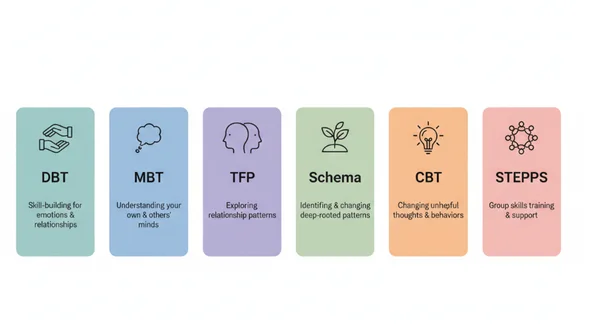
Dialectical Behavior Therapy (DBT)
DBT is the most researched and widely available treatment for borderline personality disorder. Developed by Dr. Marsha Linehan, it was designed specifically for individuals who experience intense emotions and engage in self-destructive behaviors.
DBT includes four core skill areas:
- Mindfulness — Learning to stay present and observe thoughts without judgment.
- Distress tolerance — Developing healthy ways to cope with painful situations without making them worse.
- Emotion regulation — Building strategies to manage and reduce the intensity of difficult emotions.
- Interpersonal effectiveness — Improving communication and maintaining healthier relationships.
A typical DBT program combines weekly individual therapy, group skills training, phone coaching for crisis moments, and homework assignments. Research consistently shows that DBT reduces self-harm, suicidal behavior, and hospitalizations.
Mentalization-Based Therapy (MBT)
MBT focuses on strengthening your ability to "mentalize" — to understand what you and others are thinking and feeling in any given moment, and to consider whether those assumptions are accurate.
People with BPD often struggle to accurately read social situations, which can lead to intense emotional reactions. MBT helps slow down the process of reacting so you can think before responding. It is typically delivered through a combination of individual and group sessions.
Transference-Focused Psychotherapy (TFP)
TFP is a psychodynamic therapy that uses the relationship between you and your therapist as a tool for understanding your emotional patterns. By exploring how you relate to your therapist — including feelings of trust, anger, or attachment — you can gain insight into how these patterns play out in your other relationships.
Schema Therapy
Schema therapy targets deeply ingrained negative patterns of thinking and behavior (called "schemas") that typically develop in early childhood. It blends cognitive, behavioral, and attachment-focused techniques to help individuals identify and gradually change these patterns.
This approach may be especially helpful for people who have not responded well to shorter-term therapies.
Cognitive Behavioral Therapy (CBT)
While not designed specifically for BPD, CBT can help address distorted thinking patterns that contribute to mood instability and relationship difficulties. It focuses on identifying unhelpful thoughts and replacing them with more balanced perspectives.
Systems Training for Emotional Predictability and Problem Solving (STEPPS)
STEPPS is a 20-week group program used alongside other therapies. It teaches emotion management and problem-solving skills, and uniquely involves family members or close friends in the process. This helps build a more supportive environment around the individual.
What Medications Are Used for Borderline Personality Disorder?
No medication has been specifically approved by the FDA for treating BPD itself. However, certain medications may be prescribed to help manage specific symptoms or co-occurring conditions like depression, anxiety, or impulsivity.
Common Medication Categories
| Medication Type | What It May Help With | Examples |
|---|---|---|
| Antidepressants (SSRIs) | Depressive symptoms, anxiety, low mood | Fluoxetine, Sertraline |
| Antipsychotics (low-dose) | Paranoia, anger, impulsivity, brief psychotic episodes | Aripiprazole, Quetiapine |
| Mood stabilizers | Mood swings, aggression, emotional instability | Lamotrigine, Lithium |
| Anti-anxiety medications | Severe anxiety (used cautiously) | Buspirone |
Key Points About BPD Medication
- Medication works best as a supplement to therapy, not a replacement for it.
- There is no single "BPD pill." Treatment targets individual symptoms rather than the disorder as a whole.
- Benzodiazepines are generally avoided for BPD because they may reduce inhibitions and increase impulsive behavior.
- All medication decisions should be made in close collaboration with a psychiatrist who understands BPD.
Medication can help stabilize certain symptoms, but psychotherapy remains the foundation of borderline personality disorder treatment in most clinical guidelines.
What New Treatments for Borderline Personality Disorder Are Emerging?
Research into BPD treatments continues to evolve. Several promising developments are worth knowing about.
Updated APA Practice Guidelines (2024–2025)
The American Psychiatric Association released updated practice guidelines for BPD treatment in late 2024. These guidelines reinforce psychotherapy as the primary treatment and discourage relying solely on medication for core BPD symptoms. They also highlight the importance of collaborative, person-centered care.
Neurofeedback
Neurofeedback is an emerging approach that uses real-time monitoring of brain activity to help individuals learn to regulate their own brainwave patterns. Early research suggests it may help improve emotional regulation in people with BPD, though more studies are needed.
Investigational Medications
Several clinical trials are exploring new pharmacological approaches:
- Memantine — Originally used for Alzheimer's disease, this medication targets the glutamate system and has shown early promise in reducing BPD symptoms and self-harm behaviors.
- Hormonal treatments — Estradiol-based therapies are being studied based on the hypothesis that early trauma may affect hormonal regulation in some individuals with BPD.
- Oral medications for agitation — Phase II trials are testing new drugs designed to address aggression and agitation specifically in BPD.
Repetitive Transcranial Magnetic Stimulation (rTMS)
This non-invasive brain stimulation technique is being studied at institutions like UCLA as a potential treatment for BPD symptoms. While still in the research phase, early results are encouraging.
How to Choose the Right BPD Treatment for You
With so many options available, choosing the right treatment for borderline personality disorder can feel daunting. Here are practical steps to guide your decision.
A Step-by-Step Approach
- Start with a professional assessment — A licensed mental health professional can evaluate your symptoms, identify any co-occurring conditions, and recommend a suitable treatment approach.
- Learn about your options — Understanding what each therapy involves helps you make informed choices that align with your needs and preferences.
- Consider practical factors — Availability, cost, session frequency, and whether individual or group formats are right for you all matter.
- Be open to adjustment — Your first treatment may not be your final treatment. Many people try more than one approach before finding what works best.
- Involve your support system — Family members or close friends can play an important role, especially in approaches like STEPPS.
When to Consider Inpatient or Intensive Treatment
In some situations — particularly during safety crises or when outpatient therapy is insufficient — a higher level of care may be needed. Options include:
- Partial hospitalization programs (PHP) — Structured daytime treatment while living at home.
- Intensive outpatient programs (IOP) — Multiple sessions per week with more flexibility.
- Residential treatment centers — Full-time programs offering immersive therapeutic environments.
These options are not a sign of failure. They are a sign that you are taking your recovery seriously.
Common Myths About Borderline Personality Disorder Treatment
Misinformation about BPD treatment can create unnecessary fear or hopelessness. Here are some common myths that deserve correction.
Myth 1: BPD Cannot Be Treated
This is one of the most harmful misconceptions. Multiple well-designed studies show that people with BPD can and do improve significantly with appropriate treatment. Many individuals no longer meet the diagnostic criteria after sustained therapy.
Myth 2: Medication Alone Can Manage BPD
While medication may help with certain symptoms, no drug treats the core features of BPD. Psychotherapy remains essential for lasting change — particularly therapies like DBT and MBT that build concrete coping skills.
Myth 3: Treatment Takes Forever
While BPD treatment is not a quick process, it does not necessarily last a lifetime. Research shows that many people make meaningful progress within one to two years of consistent therapy. Some individuals see improvements even sooner.
Myth 4: People With BPD Are Too Difficult to Treat
This stigmatizing belief discourages both individuals and clinicians. In reality, people with BPD can form strong therapeutic relationships and benefit enormously from treatment when they have access to providers trained in evidence-based approaches.
When to Explore Your Patterns Further
If you have been reading about borderline personality disorder treatments and wondering whether these experiences resonate with you, taking a moment to reflect on your emotional patterns can be a meaningful next step.
Understanding your tendencies — how you respond to stress, relate to others, and manage intense feelings — does not require a diagnosis. Sometimes simply organizing your thoughts can help you decide whether to seek professional support.
A BPD screening tool can help you reflect on potential patterns in a structured, low-pressure way. These tools are designed for self-understanding, not diagnosis — but they can serve as a useful starting point for a conversation with a mental health professional.
Online screening tools are not a substitute for professional evaluation. They can help you organize your observations and prepare for a meaningful conversation with a qualified clinician.
Taking the First Step Toward Recovery
Borderline personality disorder treatments have come a long way. From well-established therapies like DBT and MBT to emerging approaches like neurofeedback and rTMS, there are more options available today than ever before.
The most important thing is not which treatment you choose first — it is that you take that first step. Whether that means scheduling a consultation, learning more about your emotional patterns through a BPD self-reflection assessment, or simply talking to someone you trust, every step forward matters.
Recovery from BPD is not only possible — for many people, it is the expected outcome of consistent, quality treatment. You deserve support, and it is available.
Frequently Asked Questions
What is the most effective treatment for borderline personality disorder?
Dialectical Behavior Therapy (DBT) is the most widely studied and recommended treatment for BPD. It teaches skills for managing emotions, tolerating distress, and improving relationships. Other effective options include MBT, TFP, and Schema Therapy.
Can borderline personality disorder be cured?
BPD is not typically described as "curable," but many individuals achieve significant symptom reduction through treatment. Research shows that a large percentage of people with BPD no longer meet diagnostic criteria after several years of consistent therapy.
What medications help with borderline personality disorder?
No FDA-approved medication exists specifically for BPD. However, antidepressants, mood stabilizers, and low-dose antipsychotics may be prescribed to manage individual symptoms like depression, mood swings, or impulsivity alongside psychotherapy.
How long does BPD treatment usually take?
Treatment timelines vary, but many people see meaningful progress within one to two years of consistent therapy. Some may continue treatment longer depending on their goals and the severity of symptoms. Early engagement often leads to faster improvement.
Is inpatient treatment necessary for borderline personality disorder?
Inpatient treatment is not always necessary but may be recommended during safety crises or when outpatient therapy has not been sufficient. Partial hospitalization and intensive outpatient programs offer structured middle-ground options.
Are there any new treatments for borderline personality disorder?
Yes. Emerging approaches include neurofeedback, repetitive transcranial magnetic stimulation (rTMS), and investigational medications like memantine. The APA also released updated practice guidelines in 2024 reinforcing psychotherapy-first approaches.
Can someone with BPD have successful relationships?
Yes. With effective treatment, many individuals with BPD develop healthier relationship skills and form stable, fulfilling connections. Therapies like DBT specifically target interpersonal effectiveness and communication patterns.