Borderline Meaning: What the Word Means in Psychology, Medicine, and Everyday English
The simplest borderline meaning is "near a boundary." In everyday English, it describes something that sits between two categories, close to a limit, or not clearly one thing or the other. That may be a borderline grade, a borderline rude comment, a borderline sports call, or a borderline medical result. The word also appears in the name borderline personality disorder, so it can carry a very different meaning in psychology. If you found this page because the word made you wonder about BPD, a gentle BPD screening starting point can support private reflection, but it should not replace a conversation with a qualified mental health professional.
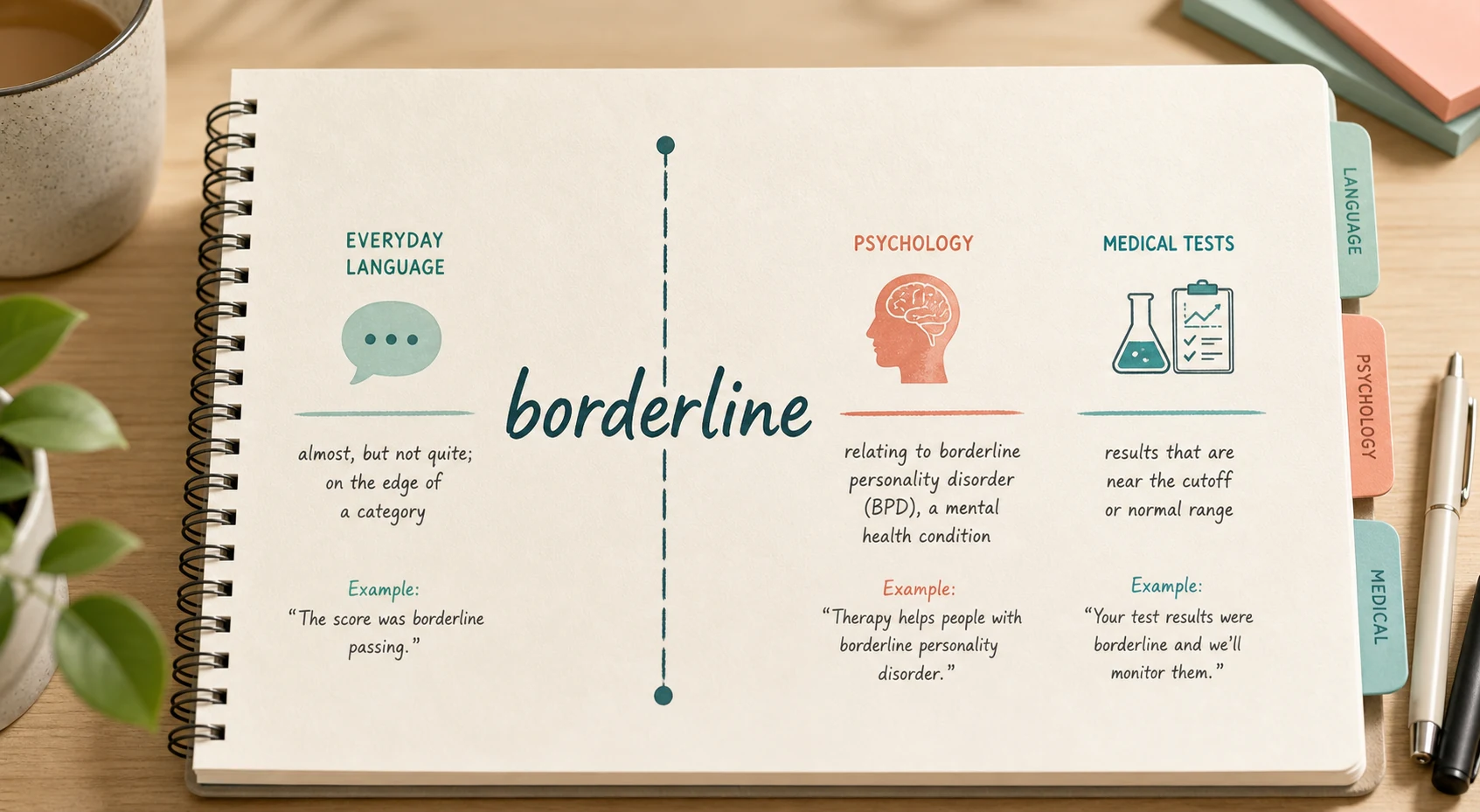
What Does Borderline Mean in Everyday English?
In ordinary speech, "borderline" usually means close to the edge of a category. It does not always mean bad, dangerous, or clinical. It simply marks uncertainty or closeness to a threshold.
As an adjective, it can describe something that is almost one thing but not clearly there. A "borderline case" is difficult to classify. A "borderline candidate" may be close to meeting a standard. A "borderline call" in sports is a call near the line where reasonable people might disagree.
As an adverb, "borderline" can mean almost or nearly. If someone says a movie was "borderline funny," they mean it was close to funny but did not fully land. If a comment was "borderline rude," it was close enough to rudeness to raise concern, even if the speaker did not intend harm.
As a noun, "borderline" can refer to the line or point where one thing becomes another. You might talk about the borderline between confidence and arrogance, friendship and romance, or caution and avoidance.
This general meaning is the key to most searches for "borderline meaning." The word points to a boundary, not a final answer.
Borderline Meaning in Psychology and BPD
In psychology, the word is most often noticed in the phrase borderline personality disorder, or BPD. In that phrase, "borderline" is not a casual insult and should not be used as a one-word label for a person. BPD is a recognized mental health condition associated with patterns such as intense emotions, unstable relationships, shifts in self-image, impulsive behavior, fear of abandonment, and feelings of emptiness. Experiences vary widely, and only a qualified professional can make a formal clinical assessment.
The term has a complicated history. Earlier clinicians used "borderline" to describe people who seemed to sit near a boundary between different categories of mental health problems. Modern use is more specific, but the word can still feel confusing because it sounds vague. That is why it helps to separate the word from the person. Someone is not "a borderline" as an identity. A person may have traits, symptoms, a clinical history, or a need for support.
If you are asking "what does it mean to be borderline," pause before turning the word into a self-label. A more useful question is: "What experiences am I noticing, and are they affecting my relationships, safety, mood, or daily life?" A free BPD self-reflection tool can help organize those observations for educational purposes, while professional support is the right next step if symptoms feel persistent, intense, or risky.
Borderline Meaning in Medical Tests, Blood Work, and ECG Results
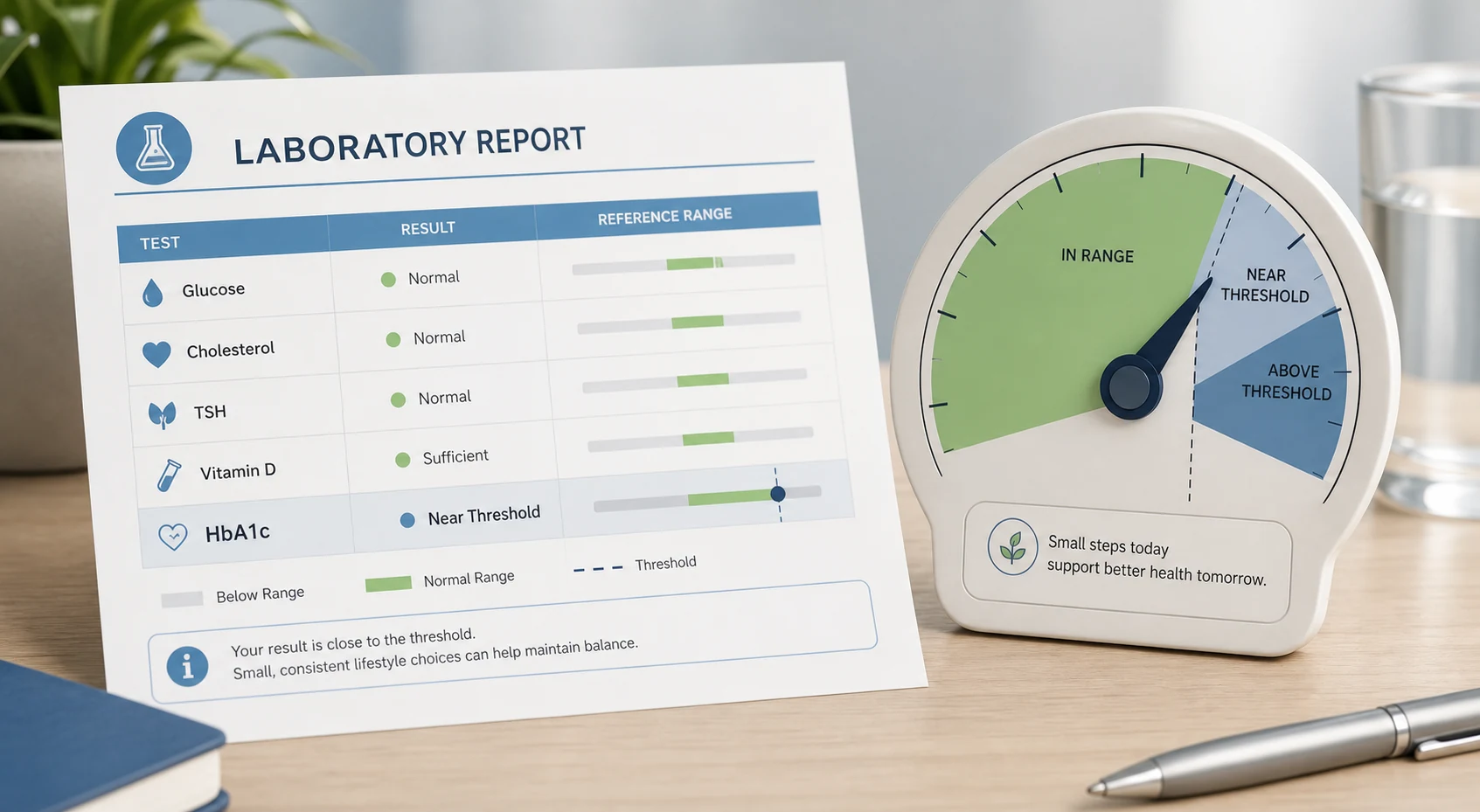
In medicine, "borderline" usually means a result is near a reference range or decision threshold. It is not automatically the same as normal, and it is not automatically a serious problem. It means the result needs context.
For example, a borderline blood test may be slightly above or below a lab's reference range. A borderline ECG or EKG may show a pattern that is not clearly normal but also not clearly abnormal. A borderline cardiomegaly note may mean a measurement is close to the size threshold used by the interpreting clinician. These phrases are not meant to be read in isolation.
Medical meaning depends on the exact test, your age, symptoms, health history, medications, prior results, and why the test was ordered. A single borderline value can matter less than a trend over time. It can also matter more if it appears alongside symptoms such as chest pain, fainting, shortness of breath, severe weakness, or sudden changes in functioning. When in doubt, ask the clinician who ordered the test what the specific result means for you.
Borderline Meaning in Slang, Sports, and Songs
In slang, "borderline" often intensifies a judgment without making it absolute. "That was borderline genius" means almost brilliant. "That was borderline unacceptable" means close to crossing a line. The tone depends heavily on context, facial expression, and what word follows it.
In sports, especially when people ask about "borderline meaning at ump," the word usually refers to a close call. A borderline pitch in baseball may be close to the strike zone. A borderline decision may be difficult for an umpire or referee because the action happened near the rule's edge.
In songs, "borderline" is usually metaphorical. It can suggest emotional uncertainty, crossing a relationship line, being near a breaking point, or living between two states of mind. Searches such as "borderline meaning song" or "Tame Impala Borderline meaning" should be read as lyric interpretation, not as a mental health explanation unless the artist or context clearly points that way. Avoid pulling a clinical meaning into a song just because the word appears there.
Borderline Meaning in Other Languages
Searches for "borderline meaning in Hindi," "borderline meaning in Urdu," "borderline meaning in Bengali," "borderline meaning in Tamil," "borderline meaning in Malayalam," "borderline meaning in Telugu," and "borderline meaning in Arabic" usually come from people trying to translate the word into a local context.
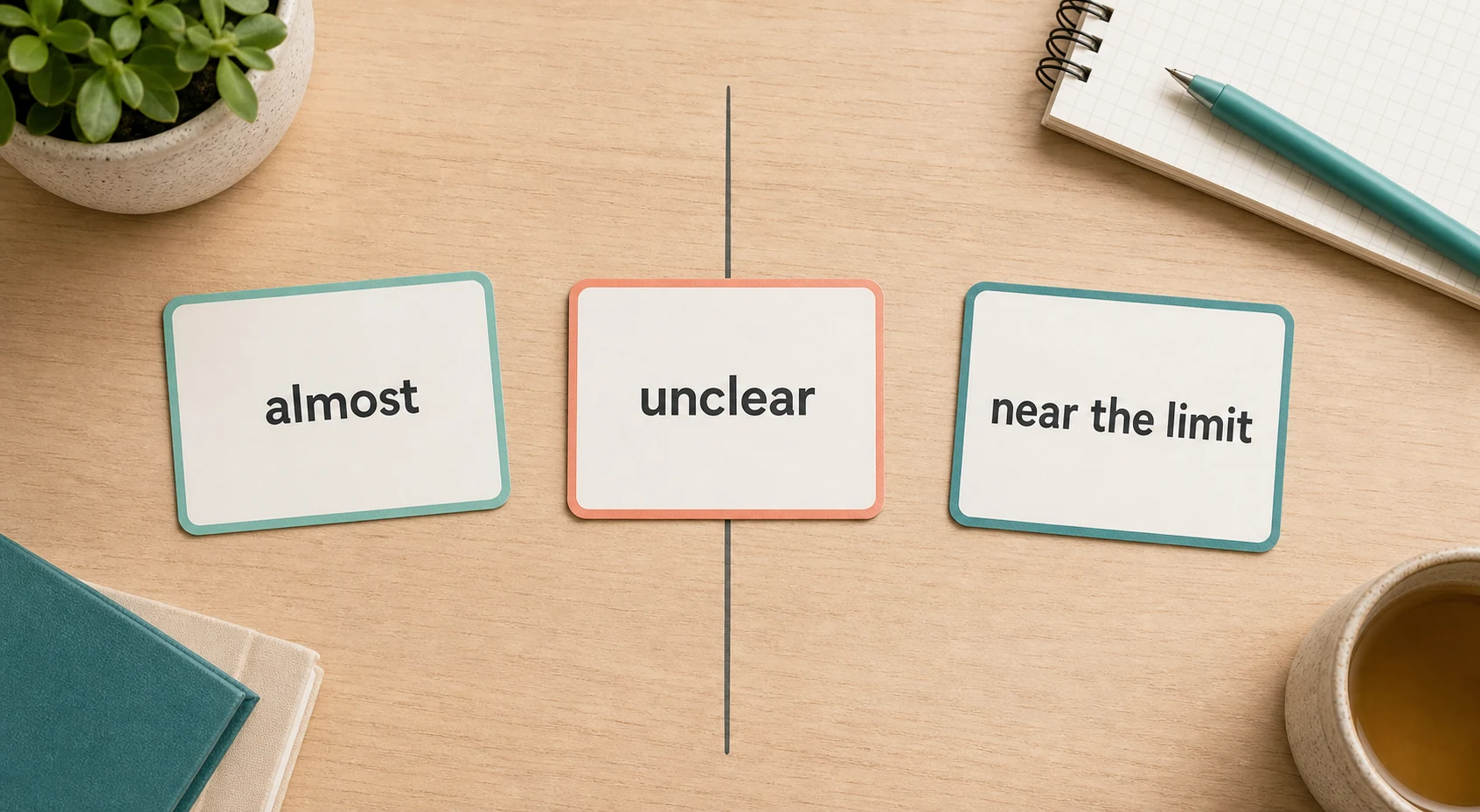
The safest translation depends on the sentence. In everyday English, the closest idea is often "near the limit," "at the boundary," "uncertain," or "not clearly in one category." In medical or psychology contexts, a direct word-for-word translation may sound too casual or too severe. For BPD, translate the full phrase "borderline personality disorder" through a reliable mental health source in that language instead of translating "borderline" alone.
Here is a practical rule: if "borderline" appears before a test result, translate it as near a medical threshold. If it appears before a personality disorder, treat it as part of a clinical term. If it appears before an everyday adjective, translate it as almost, nearly, or close to crossing a line.
How to Tell Which Borderline Meaning Applies
The fastest way to understand the word is to look at the noun after it. "Borderline result" points to testing. "Borderline behavior" may be casual, clinical, or judgmental depending on who said it. "Borderline personality disorder" points to a specific mental health term. "Borderline rude" is everyday evaluation.
Ask these four questions:
- What word comes right after "borderline"?
- Is the context casual, medical, psychological, legal, academic, or artistic?
- Is the speaker describing a measurement, a behavior, a person, or a metaphor?
- Would a less loaded word such as "unclear," "near the limit," "almost," or "close call" make the sentence clearer?
If the word is being used about a person, choose care. Calling someone "borderline" can feel dismissive or stigmatizing. It is usually better to name the behavior, emotion, or concern without reducing the person to a label.
Common Mistakes When Using Borderline
The first mistake is treating "borderline" as a final verdict. Most of the time, it signals uncertainty, closeness, or the need for more context. This is especially true for medical test results and mental health concerns.
The second mistake is assuming every use of the word refers to BPD. A borderline score, borderline foul, or borderline funny joke has nothing to do with borderline personality disorder.
The third mistake is using "borderline" as a casual description of someone you find difficult. If you are worried about a loved one's emotional patterns, focus on what you observe: intense reactions, fear of rejection, sudden shifts in closeness, impulsive choices, or distress. Then encourage support without applying a label.
The fourth mistake is panicking over the word in a report. Borderline lab or ECG language often means the result needs review with the full picture, not that one word tells the whole story.

Using the Meaning of Borderline as a Starting Point
The word "borderline" is useful when it points you toward better questions. In everyday language, it asks what boundary is being approached. In medicine, it asks what the measurement means in context. In psychology, it asks whether a pattern of experiences deserves thoughtful support.
If your search for borderline meaning is really about BPD, keep the next step low-pressure and grounded. You might write down the patterns you notice, compare them with reputable educational information, and consider whether they affect your safety, relationships, work, or sense of self. You can also use a private BPD symptom check-in as one educational reference point, then bring any serious concerns to a licensed clinician or local support service.
FAQ
What does borderline mean?
Borderline means near a boundary, threshold, or dividing line. It can mean unclear, almost, not fully in one category, or close to a limit. The exact meaning depends on whether the context is everyday speech, medicine, psychology, sports, or art.
What does it mean if a person is called borderline?
It depends on who is speaking and why. Sometimes people use it loosely to mean emotionally intense or difficult, but that can be stigmatizing and imprecise. In a mental health context, it may refer to features associated with borderline personality disorder. A person should not be reduced to the label "borderline."
What does borderline mean in BPD?
In BPD, "borderline" is part of the name borderline personality disorder. The term has historical roots in older ideas about mental health categories. Today, BPD refers to a pattern that can involve intense emotions, relationship instability, self-image shifts, impulsivity, and fear of abandonment. It requires professional evaluation, not a casual label.
What does borderline mean in a blood test or ECG?
In a blood test, ECG, or other medical report, borderline usually means the result is close to a reference range or decision threshold. It may need monitoring, repeat testing, or clinical interpretation. Ask your healthcare provider how the result fits your symptoms, history, and prior results.
What is another word for borderline?
Useful alternatives include almost, nearly, marginal, uncertain, close, unclear, liminal, near the limit, and on the edge. The best synonym depends on the sentence. "Borderline rude" might mean almost rude, while "borderline result" might mean near a threshold.
Can someone with BPD be happy?
Yes. People with BPD can experience joy, love, growth, stable relationships, and meaningful lives. Symptoms can be painful, but many people improve with appropriate support, skills, therapy, and time. It is better to think in terms of support and recovery than fixed stereotypes.
Do people with BPD truly love?
Yes. People with BPD can love deeply. Relationship distress in BPD is often connected to fear, emotional intensity, sensitivity to rejection, or difficulty regulating reactions, not an inability to care. Compassionate boundaries, communication, and professional support can help relationships become more stable.