Bipolar Disorder vs BPD: Key Differences & How to Tell Them Apart
Living with intense emotions is exhausting. One moment you might feel on top of the world, and the next, you are spiraling into despair. If you have been searching for answers, you have likely come across two terms: Bipolar Disorder and Borderline Personality Disorder (BPD).
The confusion between these two is incredibly common. Even doctors sometimes struggle to distinguish them because the symptoms often look alike on the surface. However, the root causes and treatments are very different. Understanding the distinction is the first step toward getting the right support.
This guide breaks down the critical differences between bipolar disorder vs bpd, including triggers, timing, and relationship patterns. By the end, you will have a clearer picture of your own experiences and know exactly what steps to take next. While only a professional can diagnose you, self-awareness is a powerful tool. You can start by exploring our BPD Test to gain initial insights into your symptom patterns.
Why BPD and Bipolar Are So Often Confused
It is natural to feel confused when your symptoms seem to fit both descriptions. Both conditions involve significant emotional pain, instability, and impulsive behavior. Because these surface-level traits overlap so heavily, many people spend years with an incorrect or incomplete diagnosis.
The Overlap: Mood Instability and Impulsivity
The primary reason bipolar disorder vs bpd is such a debated topic is that both conditions feature "mood swings." In both cases, you might experience:
- Intense emotional highs and lows: Periods of great energy followed by deep sadness.
- Impulsive actions: Spending sprees, reckless driving, or substance use often occur in both manic episodes and BPD crises.
- Suicidal ideation: Both conditions carry a high risk of self-harm or suicidal thoughts during low points.
- Irritability: Severe agitation is common in both mania and BPD emotional dysregulation.
Because these behaviors look similar to an outside observer, it is easy to mistake one for the other.
The Risk of Misdiagnosis: Why It Happens
Research suggests that BPD is frequently misdiagnosed as Bipolar Disorder. Why? Because the "manic" symptoms of Bipolar Disorder are often more widely recognized by general practitioners than the complex emotional patterns of BPD.
If you go to a doctor complaining of "mood swings," they might look for biological cycles (Bipolar) before investigating your relationship history (BPD). This is why understanding the nuances of your own triggers is so vital. You are the expert on your own life history, and knowing the difference helps you advocate for yourself.
4 Critical Differences: Triggers, Timing, and Patterns
While the symptoms overlap, the mechanisms behind them are distinct. To understand bipolar disorder vs bpd, you need to look at what sets off the mood swing and how long it lasts.
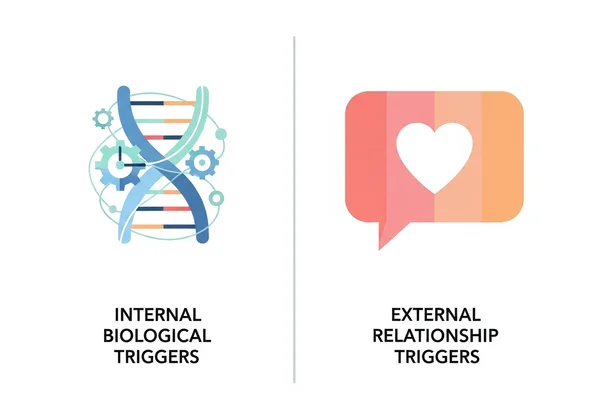
Triggers: Situational (BPD) vs. Biological (Bipolar)
This is often the most reliable way to tell them apart.
- BPD (Situational): Mood shifts in BPD are almost always reactive. They are triggered by external events, specifically those involving relationships, rejection, or failure. A fight with a partner or a perceived slight from a friend can send you into a spiral instantly.
- Bipolar (Biological): Mood episodes in Bipolar Disorder often happen without a clear external trigger. You might wake up feeling manic or depressed for no apparent reason. While stress can worsen episodes, the shift is largely driven by internal biological clocks and chemical changes, not just today’s argument.
Internal Monologue Example:
- Bipolar: "I feel like I'm the king of the world today. I have a million ideas and I don't need to sleep. Nothing special happened, I just woke up feeling electric."
- BPD: "My friend didn't text me back. She must hate me. I'm worthless and alone. The world is ending. Wait, she just texted back? Okay, I'm so happy, everything is perfect again."
Duration: The "Speed" of Mood Swings
The speed of the emotional shift is another major clue.
- BPD: Moods cycle rapidly. You can feel depressed, anxious, angry, and euphoric all within a single day or even a few hours. This is often called "emotional dysregulation."
- Bipolar: Mood episodes are sustained.
- Mania/Hypomania: Lasts for at least 4 days to a week (or longer).
- Depression: Usually lasts for at least two weeks.
- You generally do not switch from mania to depression and back multiple times in one afternoon.
Relationships: Fear of Abandonment vs. Episodic Withdrawal
How you relate to others is central to BPD but secondary in Bipolar Disorder.
- BPD: Relationships are the storm center. You likely struggle with a deep, pervasive fear of abandonment. You might idealize someone one moment ("You're my savior") and devalue them the next ("You're the worst")—a pattern known as "splitting."
- Bipolar: Relationship issues are usually a consequence of the mood episode, not the cause. During mania, you might be overly social or hypersexual; during depression, you might withdraw. But between episodes, your relationship style is typically stable.
Sleep: Disrupted Sleep vs. Decreased Need for Sleep
Sleep patterns provide a biological marker for Bipolar Disorder.
- Bipolar (Mania): You have a decreased need for sleep. You might sleep only 3 hours but wake up feeling fully rested and energetic.
- BPD: You might have trouble sleeping due to anxiety or stress, but you still feel tired and want to sleep. Your sleeplessness is usually due to emotional turmoil, not a surplus of energy.
Visualizing the Divide: Bipolar vs. Borderline Chart
Here is a quick reference guide to help you compare the key features of bipolar disorder vs bpd at a glance.
| Feature | Bipolar Disorder | Borderline Personality Disorder (BPD) |
|---|---|---|
| Primary Trigger | Internal / Biological (often random) | External / Situational (Relationship stress) |
| Duration of Moods | Days, weeks, or months | Minutes, hours, or occasionally days |
| Sleep Pattern | Decreased need for sleep during mania | Difficulty sleeping due to stress/anxiety |
| Self-Image | Changes with episode (Grandiosity vs. Worthlessness) | Consistently unstable; feeling "empty" |
| Impulsivity | Occurs mostly during episodes | Chronic; often a response to distress |
| Fear of Abandonment | Not a core feature | Central, defining symptom |
The Nuance: BPD vs. Bipolar 2 (Hypomania)
If you are reading this and thinking, "I don't get full-blown manic, but I definitely have mood swings," you might be stuck in the confusion between BPD and Bipolar 2.
Bipolar 2 involves hypomania, which is a less severe form of mania. It doesn't cause psychosis or require hospitalization, making it much harder to distinguish from BPD's emotional highs.
Hypomania vs. Emotional Dysregulation: Spotting the Difference
The key is still the duration and quality of the high.
- Hypomania (Bipolar 2): Lasts at least 4 consecutive days. It is a distinct period where you are persistently elevated, expansive, or irritable. It feels like a "break" from your normal self.
- Emotional Dysregulation (BPD): Is usually reactive and short-lived. You might feel euphoric because your partner complimented you, but that feeling can vanish the moment a minor conflict arises.
If your "highs" are always tied to good news or relationship success and fade quickly, it points more toward BPD.

Gut Check: Analyzing Your Emotional Patterns
Before we move to the next steps, take a moment for honest self-reflection. Read the statements below. Which set resonates more with your daily life?
Group A:
- My mood changes are usually caused by something someone said or did.
- I often feel "empty" inside and don't know who I really am.
- I am terrified that people I love will leave me.
- My emotions switch from happy to sad in a matter of minutes.
Group B:
- My mood changes happen gradually and last for weeks at a time.
- I have periods where I don't need much sleep but still have tons of energy.
- My relationship issues only happen when I am feeling "high" or "low."
- Between mood episodes, I feel relatively stable and "normal."
Reflection: If you found yourself checking mostly Group A, your patterns strongly align with BPD traits. If Group B felt more familiar, Bipolar Disorder might be the primary driver. If you checked boxes in both, keep reading.
Can You Have Both? (Comorbidity)
Yes, it is possible to have both Bipolar Disorder and BPD. This is known as comorbidity or dual diagnosis.
Research suggests that about 20% of people with Bipolar Disorder also have BPD. When these conditions coexist, symptoms can be more severe. The mood episodes of Bipolar Disorder can lower your threshold for BPD triggers, making emotional reactions even more intense.
Diagnosing comorbidity is complex because the symptoms mask each other. For example, the impulsivity of BPD might be mistaken for a manic symptom. This complexity is exactly why a comprehensive professional evaluation is necessary—but gathering your own data first can speed up that process.
Turning Insight into Action: The Role of Self-Screening
You have learned about the triggers, the timing, and the nuances of bipolar disorder vs bpd. But reading about symptoms is passive; understanding how they apply to you requires action.
Why Self-Awareness is the First Step
Walking into a doctor's office and saying "I have mood swings" can sometimes lead to a quick, generic diagnosis. However, if you can say, "I've noticed my moods switch rapidly in response to rejection," or "I have weeks of energy regardless of what happens in my life," you provide the doctor with crucial data.
Self-knowledge is your best advocacy tool. It helps you ask better questions and ensures your treatment plan targets the right root cause.
Try Our AI-Enhanced Screening Tool
If the descriptions of relationship triggers, rapid mood shifts, and fear of abandonment resonated with you, it is worth exploring these traits further.
We have developed a free, anonymous tool designed to help you analyze your symptom patterns. It isn't a medical diagnosis, but a way to organize your experiences into a clear picture.
- Gain Clarity: See which specific BPD traits you might be exhibiting.
- Prepare for Therapy: Get a personalized analysis that you can share with a professional.
- Safe Exploration: No judgment, just data to help you understand yourself.
Moving Forward with Clarity
Whether you are dealing with Bipolar Disorder, BPD, or a mix of both, remember that both conditions are treatable.
- Bipolar Disorder is often managed effectively with mood stabilizers and lifestyle changes to regulate biological rhythms.
- BPD responds incredibly well to specialized therapies like Dialectical Behavior Therapy (DBT), which teaches skills to manage emotions and relationships.
You do not have to live at the mercy of your emotions forever. By educating yourself on the differences between bipolar disorder vs bpd, you have already taken a massive step toward stability. Use the tools available to you, seek professional guidance, and be patient with yourself as you navigate this journey.
Frequently Asked Questions
Which is considered "worse", Bipolar or BPD?
Neither is "worse"; they simply present different challenges. Bipolar Disorder can be dangerous due to the risk of manic behavior and deep depression. BPD is often described as extremely painful emotionally due to the chronic feelings of emptiness and relationship turmoil. Both deserve compassion and serious care.
Can BPD be treated effectively?
Yes, absolutely. Unlike the old stigma that personality disorders are permanent, modern research shows BPD has a very positive prognosis. Therapies like DBT have high success rates in helping people achieve remission and live stable, fulfilling lives.
What is the main difference in treatment?
The primary difference is the focus. Bipolar treatment usually prioritizes medication (like mood stabilizers) to manage the biological aspect of mood swings. BPD treatment prioritizes psychotherapy (talk therapy) to learn coping skills for emotional regulation and relationship management. Medication may be used in BPD, but it is usually secondary.
Can I diagnose myself with these conditions?
No, you cannot diagnose yourself. Both conditions are complex and require a trained professional to rule out other causes. However, you can use screening tools like our online BPD assessment to identify patterns and "red flags" to discuss with your doctor. Self-screening is a powerful first step in the diagnostic process.